
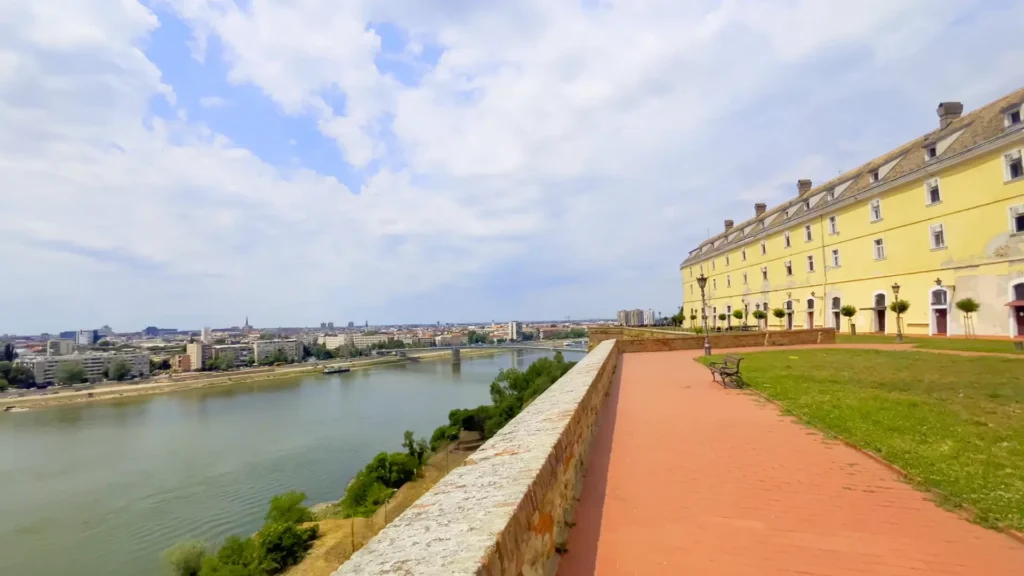
Novi Sad sits about 80 to 95 km north of Belgrade, and the fast train gets you there in around 35 minutes.
One detail changes the plan. Novi Sad’s main railway station has been closed since November 2024, so trains from Belgrade stop at Petrovaradin, across the Danube from the old town. A free shuttle bus covers the last stretch.
Five routes work: the Soko train, the bus, a transfer from Belgrade airport, a car and a guided tour. They drop you in different places, and the drop-off point shapes your day more than the travel time does.
If you’re staying overnight, the second half covers the four neighborhoods worth considering and a map for comparing hotels and apartments.
This post contains affiliate links. If you book through them, I may earn a commission at no extra cost to you.
Times, prices and rules below come from public guides and transport pages as of October 2026. Timetables change, so check a current one (for example Everyrail’s Srbija Voz page) before you travel.
Belgrade to Novi Sad at a glance
| Route | Time | You arrive at | Best for |
|---|---|---|---|
| Soko fast train | about 35 minutes | Petrovaradin station | A day trip |
| Bus | 1 to 1.5 hours | Novi Sad bus station | A backup when trains sell out |
| Airport transfer | about 1 hour for 80 km | The address you give | Landing with luggage |
| Car | about 1 hour on the E75 | Your hotel or a car park | Fruška Gora and Sremski Karlovci |
| Guided tour | a full day | Stops chosen by the operator | Skipping the logistics |
I’d take the train for a day trip and the bus when the train is full. A car only pays off if you want the hills outside the city.
What Novi Sad is like
Novi Sad is Serbia’s second-largest city, and it feels calmer than Belgrade. The old center is compact, the Danube runs along its edge and a hilltop fortress overlooks the water from the far bank.
The city carried the title of European Capital of Culture, and you notice it in the museums, the galleries and the pedestrian streets. Most of what a visitor wants sits within a short walk of Liberty Square.
That makes it a good partner for Belgrade. The capital gives you scale, late nights and a lot of history, and Novi Sad gives you a slow day on a river.
Option 1: the Soko fast train
The Soko is the best way to reach Novi Sad, and one French rail guide nicknames it the “Balkan TGV.” The line was built for speeds up to 200 km/h and finished in March 2022, and the trains cover the distance in about 35 minutes.
Where it leaves
Soko trains leave from Beograd Centar, also called Prokop. It’s Belgrade’s main long-distance station, and buses stop right in front of it. The city center is about 3 km away.
An older tip says to board at Novi Beograd, which sits closer to the airport. One 2026 guide says Novi Beograd is closed for boarding from 9 September to 31 December 2026 because of construction. Go to Beograd Centar and you avoid the question.
Tickets and the seat reservation
Soko trains require a seat reservation, priced at around RSD 120. The reservation sits on top of the fare, so a ticket without it won’t get you on board. A rail pass covers the base fare, and the reservation costs extra.
The fare itself depends on the source. A 2024 trip report paid 393 RSD for the slow train and 962 RSD for the fast one. A 2026 guide says a 2nd-class Intercity fare from Beograd Centar to Petrovaradin cost 679 RSD after a tariff change on 15 July 2026, plus the reservation.
From those two figures, I’d budget roughly RSD 800 to 1,100 each way, reservation included. Check the real price at the station.
You can buy tickets at the machines or the ticket office. The 2024 traveler bought theirs on the day, and I’d do that on a quiet weekday. On weekends, seats on this train get scarce, so book ahead.
How often it runs
Soko trains run from Belgrade every 30 to 60 minutes. The ride takes about 36 minutes, and another guide says closer to 30.
Pick a morning departure for a day trip, and look up the last train home before you leave. Skip the long dinner until you know it.
Where it arrives
Trains stop at Petrovaradin station, on the far side of the Danube from the old town. Free shuttle buses run from there to the city center. They wait on Preradovića street and return from Uspenska street.
The reason is a sad one. On 1 November 2024, a concrete canopy at Novi Sad’s main station collapsed and killed 16 people. The building has stayed closed to passengers since.
Confirm the arrival station before you go. A 2026 guide and a 2026 conference page both say trains still stop at Petrovaradin, and that could change.
In 2025, the city’s mayor said officials were looking for a way to restore the station’s functions as soon as possible. If the main station reopens, the arrival point will change again.
Here’s a plan that takes advantage of the arrival. Petrovaradin Fortress sits on the same side of the river, so start your day there and walk across the bridge into the old town later. Check the walk from the station on a map first.
The trip, step by step
Here’s how the day runs from your hotel in Belgrade.
Go to Beograd Centar and buy your ticket and seat reservation at the machines or the office. Look up the last train home while you’re there, and ask whether the counter sells the return at the same time. A return in hand takes the stress out of the evening.
Board your train and ride for about 35 minutes. You’ll cross the flat plains of Vojvodina, and the Danube appears as you approach.
At Petrovaradin, follow the other passengers to the shuttle stop on Preradovića street if you’re heading to the city center. If you’re going to the fortress, check the walk on a map before you set off.
On the way back, the shuttle returns from Uspenska street. Leave a margin of at least 30 minutes before your train.
Option 2: the bus
Buses leave Belgrade’s main bus station about every half hour, according to one guide, and take roughly 1.5 hours. Another guide gives 1 to 1.5 hours, depending on traffic. One traveler reported about an hour and $7.
The bus is slower than the train, and it has two real advantages. You don’t need a reservation, and it runs when the train sells out.
Buses end at Novi Sad’s bus station. It sits on the plateau next to the closed railway station, and local city buses serve it. That makes the bus a decent choice when you want a city bus straight to your hotel.
Buy the ticket at the station. I haven’t found a reliable current price, so check the counter or the timetable board.
Option 3: from Belgrade airport
Belgrade’s Nikola Tesla Airport is about 80 km from Novi Sad, and the drive takes roughly an hour. Shuttles and taxis connect the two.
You can also go in two steps. Take a taxi or bus to Belgrade’s central bus station, then catch a coach from there. That saves money and costs time, and it means handling your luggage twice.
A private transfer gets you door to door. One transfer company describes a driver who collects you and drives about an hour, at a fixed price. It costs more than a ticket and saves effort.
My rule: if you’re landing in the afternoon with a heavy bag and a hotel booked in Novi Sad, pay for the transfer. If you’re traveling light and the train is running, take the train from Beograd Centar.
Option 4: by car
The E75 links Belgrade and Novi Sad, and the drive takes about an hour.
A car makes sense for one reason: the countryside. Fruška Gora National Park lies about 20 minutes’ drive south of Novi Sad, and the baroque wine town of Sremski Karlovci sits about 8 km away.
In the city, you won’t need the car. The center is walkable, and parking near the old town costs time. If you rent one, leave it at your hotel.
Option 5: a guided day tour from Belgrade
Several operators run full-day tours from Belgrade that combine Novi Sad with Sremski Karlovci and a stop in the Fruška Gora hills. One listing describes a day that visits Krušedol monastery, the baroque town of Sremski Karlovci and Petrovaradin Fortress, with a Bermet wine tasting and free time in the city.
A tour solves the logistics. Someone else handles the transport, the stops and the timing, and you don’t need to worry about the shuttle or the last train.
The cost is flexibility. You follow the operator’s schedule, and a stop you love ends when the group moves on.
Choose a tour if you want the hills and the wine and you’d rather not drive. Choose the train if you want to linger in the old town.
Compare the itinerary, the group size and the cancellation terms before you pay. One operator’s listing advertises free cancellation, and that’s worth looking for.
Which route should you take?
The train wins for a day trip. It’s fast, it’s cheap and it lands you near the fortress.
The bus wins when the train is full, or when you want to arrive at the plateau where the city buses leave.
A transfer wins for travelers arriving by air with luggage. A car wins only if Fruška Gora is on your list, and a tour wins if you want the hills without the driving.
If you’re torn, pick by how you end the day. A day trip needs the train home, and an overnight stay can use any route.
Is Novi Sad worth the trip?
Yes, if you like a walkable city with a river and a fortress. It suits a day or a night, and it pairs well with Belgrade.
Skip it if you’re short on time and want the capital’s nightlife and scale. Three days in Belgrade is plenty without it.
Go if you’ve already seen Belgrade’s main sights and want a slower pace. The train makes it easy, and the fortress alone repays the ride.
Day trip or overnight?
A day trip works because the train is so quick. With a 35-minute ride, you can see the fortress, the old town and a long lunch, and still be back in Belgrade for dinner. My 3-day Belgrade itinerary swaps Day 3 for exactly this trip.
Stay in Belgrade or in Novi Sad?
Decide this before you book anything, because it changes where your money goes.
Stay in Belgrade if you have 3 days or more there and Novi Sad is one outing. The train takes about 35 minutes each way, so a Belgrade hotel works as a base for the whole trip, and you unpack once.
Stay in Novi Sad if you want more than a day. An evening on the pedestrian streets, a quiet morning at the fortress and a trip to the hills outside town all need a night.
A mixed plan works too. Spend 2 nights in Belgrade, take the train for 1 night in Novi Sad and return to the capital for the last day. Check train times first, since the last service home sets your evening.
If you do one night, pick the center or Petrovaradin and book early on weekends.
Combining Novi Sad with Belgrade
Here’s a simple way to fit it into a longer trip.
If you have 4 days in Serbia, spend 2 on Belgrade’s sights, take a day for Novi Sad and use the last day for whatever pulled you most. My 3-day Belgrade itinerary gives you the Belgrade days, and Novi Sad slots into the third one.
If you have 5 days or more, add a night in Novi Sad and a day in the hills, then return to Belgrade for your flight. Check train times for your last day first, since a morning departure leaves little margin.
If you can, keep your Belgrade room for the whole stay. Many hotels also hold bags for you, so ask before you leave and travel to Novi Sad with just an overnight bag.
What to do in Novi Sad in one day
Here’s a simple order for a day, built around the Petrovaradin arrival.
Morning: Petrovaradin Fortress
Petrovaradin Fortress stands on a bluff above the river, and it’s the city’s signature sight. Construction began in 1692, and building went on for 88 years.
The complex has an Upper Town and a Lower Town. The Upper Town holds the old barracks, the clock tower and the city museum.
The Lower Town has officers’ houses, the Church of St. George and the baroque Belgrade Gate.
The clock tower is the one to look for. Its minute and hour hands are reversed, so fishermen on the Danube can read the time from far away.
Under the fortress runs a system of tunnels, about 16 km long and finished in 1776. Visitors can explore roughly 1 km of it with a guide. One travel listing says the fortress is open Tuesday to Sunday, and fees apply for the museum and the tunnel tour.
You can walk the grounds without a ticket. Give it about 2 hours, or an hour if you stick to the clock tower, the viewpoints and the walls.
More inside the fortress
Petrovaradin is one of the largest citadels in Europe, and it sits on a volcanic bluff above the river. Locals and guides call it the “Gibraltar of the Danube.”
Inside the walls you’ll find artist workshops and the City Museum, which covers the citadel’s history, its military equipment and some notorious prisoners. A French rail guide also mentions a Museum of Space and a recently renovated clock tower.
Entry to the grounds is free, and museums charge their own fees. Pick one museum at most on a day trip, and spend the rest of the time on the walls.
Midday: across the bridge to the old town
Walk across Varadinski Bridge into the city. The view back to the fortress is worth a pause.
Liberty Square is the center of the old town. The neo-Renaissance City Hall and the neo-Gothic Name of Mary Church stand on it, and the Orthodox cathedral is close.
Zmaj Jovina is the pedestrian street nearby, lined with cafés, pubs and restaurant terraces. It’s a good place for lunch.
Afternoon: Dunavska Street and the Danube
Dunavska Street holds the Museum of Vojvodina and the Museum of Contemporary Art. It leads down toward the river, and Danube Park is at the end.
In summer, the Štrand beach on the Danube is the place for a swim. It’s about a half-hour walk from both the fortress and the city center.
I’d skip the museums on a short day and use the time to sit in the park. A day trip has too little room for everything.
Museums and galleries
Novi Sad has more culture than a day trip can hold, so pick one or two.
The Museum of Vojvodina, in a 19th-century palace on Danube Park, documents 8,000 years of life in the region. The Museum of Contemporary Art Vojvodina sits nearby, and the City Museum inside the fortress covers the citadel’s history.
The Gallery of Matica Srpska is the art stop. It’s run by Serbia’s leading cultural institution and holds what’s considered the richest collection of Serbian art, with more than 7,000 pieces.
If you prefer buildings to galleries, look at the Church of the Name of Mary on Liberty Square, built in 1895 and the largest Catholic church in the city. The Synagogue, built in 1909 and designed by the Hungarian architect Lipót Baumhorn, sits on Jevrejska Street.
The riverfront and Štrand
The Danube is the city’s living room. Štrand is a sandy stretch about 700 meters long, and one guide says it’s open all year and comes into its own from May to September.
In summer, pop-up bars, ice-cream stands and picnic spots appear along the shore. In the off season, the quay is still good for a long walk.
Cycling
Novi Sad has an extensive network of bike paths, and the French rail guide calls it Serbia’s number-one cycling city. The EuroVelo 6 route, which links Budapest and Belgrade, passes through it along the Danube.
If you like to ride, the paths along the river are the pick. Ask your hotel about rentals, because I haven’t found current prices or shops.
Markets
For local food to take home, the Limanska and Futoška markets sell ajvar, honey and homemade rakija, according to the same guide. A jar of ajvar travels well, and rakija bottles need careful packing in a carry-on or a checked bag.
Evenings
Evenings center on the pedestrian streets. Zmaj Jovina Street has the café and restaurant terraces, and Laze Telečkog Street is lined with bars and pubs.
One listing also mentions a craft beer scene and small jazz clubs. Ask your host which bar is busy this week, since venues change.
With kids
Novi Sad suits families. Štrand is the obvious summer stop, and one guide lists it as the top pick for family days out. Danube Park is a good break between sights, and the Museum of Vojvodina is the one museum I’d try with children.
The fortress walls and the tunnel tour work for older kids. Check the tour’s age rules before you book.
Free things to do
You can fill a day without spending much. The fortress grounds, the walk over Varadinski Bridge, Danube Park, the Danube quay and the people-watching on Zmaj Jovina Street all cost nothing.
Add Štrand if it’s summer. Entry costs vary, and I haven’t found a current figure, so check on arrival.
A sample timetable
Treat these times as a draft, because you’ll need to check real departures.
- 09:00: take the Soko from Beograd Centar
- 09:40: arrive at Petrovaradin and walk to the fortress
- 10:00 to 12:00: walls, clock tower and viewpoints
- 12:15: cross Varadinski Bridge into the old town
- 12:45: lunch on or near Zmaj Jovina Street
- 14:30: Liberty Square, then Dunavska Street
- 16:00: Danube Park, or a swim at Štrand in summer
- 17:30 or later: shuttle bus and train back to Belgrade
That leaves a margin before the last train, which I’d keep. Add the tunnel tour only if you start earlier.
Eating in Novi Sad
Novi Sad sits in Vojvodina, a region whose cooking shows Central European and Balkan influences side by side. The official Serbian tourism site describes a fishermen’s cuisine built on the Danube and Tisa rivers, plus a heavier continental cuisine shaped by the many peoples who’ve lived here.
Fish is the local specialty. Carp and catfish are common, and fish paprikaš, a paprika-based stew, is the dish travel writers keep recommending. If you eat one regional dish, make it that.
For something meatier, look for the “Sunday lunch of Vojvodina.” It runs from a noodle or dumpling course through beef in sauce to breaded and roast meats, then ends with a dessert such as pancakes or strudel. Kulen, a spiced pork sausage, and cracklings show up as side dishes.
Zmaj Jovina Street is the easy choice for lunch, with terraces along the pedestrian stretch. Prices tend to run higher on the main street than a block or two away, so wander before you sit.
Vegetarians and vegans will find fewer options. Traditional Serbian cooking leans on meat, though a few restaurants serve meat-free versions of dishes like sarma and stuffed peppers.
I haven’t named restaurants here, because I haven’t eaten at any of them. Ask your host which terrace they like.
If it rains
Rain doesn’t wreck the day. The fortress museum and the tunnel tour are both indoors or underground, and the museums on Dunavska Street fill a wet afternoon.
Café terraces on Zmaj Jovina Street often have covered sections, and a long lunch is a fine plan. Save the walk over the bridge for a break in the weather.
If you stay a night
A night gives you a different city. The day trippers leave, and the old town’s pedestrian streets settle into the evening.
On day one, do the fortress and the old town as in the timetable above, then eat on or near Zmaj Jovina and walk the river at dusk.
On day two, head out to Sremski Karlovci and Fruška Gora, or spend the morning at Štrand if it’s summer. Return by train in the afternoon, and book your seat early on weekends.
Sremski Karlovci in more detail
Sremski Karlovci is a baroque town about 8 km from Novi Sad. Its main square holds the Four Lions Fountain and the Serbian Orthodox cathedral, and the Chapel of Peace stands where a peace treaty was signed.
The town is also known for Bermet, an aromatic dessert wine made locally. One tour listing says it was once on the Titanic’s wine list, and that the old cellars offer tastings.
Plan on a half day. A tour or a taxi gets you there, and I haven’t found current bus timetables.
Fruška Gora and its monasteries
Fruška Gora is a wooded ridge south of Novi Sad, and it holds one of Serbia’s five national parks. Tours call it the Holy Mountain of Serbia, and listings count 16 or 17 active Orthodox monasteries there.
Krušedol is the one tours mention most. The lower slopes carry vineyards, so a monastery visit and a wine tasting fit into one day.
Dress as you would for any Orthodox church, with covered shoulders and knees. Check opening hours before you drive out.
Where to stay in Novi Sad
Novi Sad is compact, and most visitors choose between four areas. Each one trades walking distance for quiet or views.
The city center (Stari Grad)
The center has the best walking access to the sights. Liberty Square, Zmaj Jovina Street and Dunavska Street are all within a few minutes on foot.
The cost is noise on warm evenings. Pedestrian streets with café terraces stay lively late.
This is where I’d stay on a first visit, especially for a night or two.
Petrovaradin
Petrovaradin sits across the Danube, below the fortress. It has views, an old-town feel and an easy walk to the clock tower and the viewpoints.
You cross the bridge to reach the city center, and fewer restaurants and bars sit on this side, so expect to head downtown for an evening out.
Petrovaradin is also where your train arrives, which makes it handy for an early or late service. It suits travelers who care more about the fortress than the evening scene.
Liman
Liman is a green residential district near a large park. It suits families and longer summer stays.
The drawbacks are less historic charm and fewer attractions on the doorstep.
Grbavica and Bistrica
These residential areas sit just beyond the center. Travel sites list places within walking distance of Freedom Square and the Serbian National Theatre.
They tend to be calmer than the center. Skip them on a short trip, when you want the old town at your door.
Apartments for a week or more
Apartments and vacation rentals suit stays of a week or longer. If you’re testing the city for a longer stay, that’s the better format. My guide to moving to Europe from the USA covers the permits that make long stays possible.
How to book smart
Pick the arrival point first. If your train stops at Petrovaradin and you want an early start at the fortress, a room there saves a shuttle ride.
Check the check-in time against your arrival. A morning train often lands you before check-in, so ask if the hotel can hold your bag.
Choose flexible cancellation where it’s offered. Train sales, weather and plans change, and a free cancellation window costs little.
Look at the map before you look at the price. A cheap room across the river from where you want to be costs you time every day.
Read recent reviews for noise, especially for rooms facing the pedestrian streets in summer.
Choosing by traveler type
| If you are | Stay in |
|---|---|
| A first-timer on one night | The city center |
| Arriving late or leaving early by train | Petrovaradin |
| Here for the fortress and the views | Petrovaradin |
| Visiting in summer with family | Liman |
| Staying a week or longer | An apartment in the center or Liman |
| Watching your budget | Grbavica or Bistrica |
The table is a starting point. Prices change by date, so compare real rooms on the map.
Compare places on the map
For another view of the neighborhoods, MileHacker’s guide goes into more detail. Use the map below to compare hotels and apartments in these four areas.
Getting around Novi Sad
The center is walkable, and a large part of it is pedestrian. You’ll cover most sights on foot.
Local buses (JGSP) serve the plateau by the closed railway station. To reach the fortress by public transport, one guide says to take a bus to the corner of Beogradska and Lisinskog. Walking the bridge is the more scenic option.
I haven’t found reliable taxi fares, so agree on the price or insist on the meter before you set off.
When to go
Summer is the easy season. Evenings along the pedestrian streets stay lively, and the Štrand beach is open for swimming.
Spring and autumn suit the fortress best, with cooler walking weather and thinner crowds. Winter is quiet, and the outdoor sights are still open.
Festival weeks fill hotels in any year, so check local event dates before you book a room.
Food and drink fans have dates to note. The official tourism site lists the International Wine Festival and the Kovilje Rakija Fest in June, and the Futog Cabbage Festival in October.
Money and practical notes
The currency is the Serbian dinar (RSD), at roughly 117 to the euro. Keep some cash for the bus counter, the shuttle and small purchases.
Hotels register foreign guests with the police for you, so bring your passport to check-in. Apartment hosts handle this too, and it’s worth asking.
Demonstrations followed the station collapse, in Novi Sad and across Serbia, according to Railway Gazette. Most visitors never see them, and I’d still check your government’s current travel advice before you book.
If you hold a rail pass, the base fare is covered and the seat reservation is not. Reserve in advance for weekend trains.
A few useful words
Serbian is written in both Cyrillic and Latin letters, and you’ll see both on signs and menus.
“Dobar dan” means good day, and “hvala” means thank you. A greeting in the local language goes a long way at a bakery counter or a hotel desk.
At the ticket window, “jedna karta do Novog Sada, molim” means one ticket to Novi Sad, please. “Gde je autobuska stanica?” asks where the bus station is.
What it costs
Costs are small compared with most European day trips. Here’s what I found:
| Item | What I found |
|---|---|
| Soko seat reservation | around RSD 120 |
| Train fare | roughly RSD 700 to 1,000, depending on the source |
| Bus | about $7 in one traveler’s report |
| Petrovaradin grounds | free to walk |
| Fortress museum and tunnel tour | paid, at the site |
| Shuttle from Petrovaradin to the center | free |
| Hotels and apartments | check the map for your dates |
A day trip by train comes to roughly RSD 1,600 to 2,200 for the return, reservations included. That’s my arithmetic from the figures above, so treat it as a ballpark.
Saving money on the trip
The cheapest version is a morning train, a day of walking and the bus or train home. The fortress grounds, the bridge and the old town’s streets cost nothing, and the shuttle from Petrovaradin is free.
Book trains on a weekday if you can. Weekend seats get scarce, and the bus is the fallback.
Spend where it counts. The tunnel tour and the museum fee are the extras worth considering, and a tour from Belgrade costs more than the train if you want the hills.
Hotels are the real swing. Compare dates on the map, since prices change by night.
Mistakes to avoid
Expecting the train to arrive in the center is the big one. It stops at Petrovaradin, and the shuttle bus covers the rest.
Skipping the reservation is the next. Without it, you can’t board a Soko train.
Leaving it to the last minute on a weekend is an easy way to lose a seat. Book ahead, or have the bus as a backup.
Forgetting the last train home is a quiet one. Look it up before you start your dinner.
Booking a hotel without checking the arrival point costs you time. If your train stops in Petrovaradin, a room there saves a shuttle ride.
Cramming in everything is a trap. Novi Sad rewards a slow lunch, and a day trip has room for the fortress and the old town.
Names to know
A handful of names come up again and again when you plan this trip.
Beograd Centar, also called Prokop, is Belgrade’s main long-distance train station. Petrovaradin is where Soko trains stop in Novi Sad now, across the Danube from the old town.
Soko is the fast train, nicknamed the Balkan TGV. Srbija Voz is the national railway company, and JGSP runs Novi Sad’s city buses.
The Belgrade bus station is the main departure point for coaches. Liberty Square is the heart of Novi Sad’s old town, and Zmaj Jovina is its pedestrian street.
Štrand is the city beach on the Danube. Fruška Gora is the wooded ridge and national park south of the city, and Sremski Karlovci is the baroque wine town at its foot.
Before you go: a short checklist
Run through this the evening before.
- Check the timetable for the Soko and note the last train home
- Buy your seat reservation, or plan to buy it at the station early
- Decide whether you’re heading to the fortress first or the old town
- Carry some dinars for the bus counter and small purchases
- Bring your passport if you’re staying overnight
- Save the shuttle stops on Preradovića and Uspenska streets in your phone
- Check the weather and pick a rain plan if it looks wet
Conclusion
Novi Sad is the easiest big escape from Belgrade. The fast train takes about 35 minutes, the bus covers the days when the train is full, and a few kilometers of walking take you through the old town.
Plan for the Petrovaradin arrival, book your seat on weekends and decide early whether you want one day or two. If you stay, use the map to pick a neighborhood.
For the rest of the trip, my 3-day Belgrade itinerary shows where Novi Sad fits, and the list of 14 things to do in Belgrade covers the capital. More trips are in the Europe guides.
Tell me in the comments if you’ve taken the train since the station closed, and how the shuttle worked.
FAQs
How long does the train from Belgrade to Novi Sad take?
About 35 minutes on the Soko fast train. Slower trains take longer, and the bus takes 1 to 1.5 hours.
Which station does the train arrive at in Novi Sad?
Petrovaradin, across the Danube from the old town. Novi Sad’s main station has been closed since November 2024. A free shuttle bus runs from Petrovaradin to the center.
Is Novi Sad’s railway station open?
Not for passengers, as of the 2026 guides I read. Trains stop at Petrovaradin instead. Check a current timetable before you travel, because this could change.
How much is the train from Belgrade to Novi Sad?
Roughly RSD 700 to 1,000 for the fare, plus about RSD 120 for the required seat reservation. Guides disagree on the exact fare, so check at the station.
Do I need to book the Soko train?
You need a seat reservation, and you can buy it with your ticket. On weekends, trains can sell out, so book ahead.
Is the bus or the train better?
The train is faster and lands you near the fortress. The bus is slower and runs when the train is full, and it ends at the bus station next to the closed railway station.
Can I go from Belgrade airport to Novi Sad directly?
Yes. It’s about 80 km and roughly an hour by shuttle, taxi or private transfer. You can also take a taxi or bus to Belgrade’s central station and continue by coach or train.
Is Novi Sad worth a day trip from Belgrade?
Yes. The fortress, the old town and a long lunch fit into a single day, and the train is quick enough to make it easy.
Where should I stay in Novi Sad?
The city center is the best base for a first visit, because Liberty Square, Zmaj Jovina Street and Dunavska Street are all within a short walk. Petrovaradin suits fortress lovers, and Liman suits longer summer stays.
Can I swim in Novi Sad?
Yes, at Štrand beach on the Danube. One guide says it’s open all year and busiest from May to September. It’s roughly a half-hour walk from the fortress and the center.
Can I cycle from Belgrade to Novi Sad?
The EuroVelo 6 route runs along the Danube between Budapest and Belgrade and passes through Novi Sad. I haven’t checked the stretch from Belgrade, so look at the route and the surface before you plan it as a day ride.
When is the best time to visit Novi Sad?
Summer for the beach and long evenings, and spring or autumn for walking the fortress. Winter is quiet, and the outdoor sights stay open.
How far is Petrovaradin Fortress from the old town?
They face each other across the Danube, joined by Varadinski Bridge. The walk across is short, and the bridge is the most scenic way to go.
Do I need cash in Novi Sad?
Carry some dinars for the bus counter, the shuttle and small purchases, and ask at smaller places whether they take cards.
Is a day trip from Belgrade enough?
For the fortress, the old town and a long lunch, yes. Stay a night if you want Sremski Karlovci, Fruška Gora or a slow evening by the river.
Is Novi Sad safe for tourists?
Most visitors have an easy time. Demonstrations took place after the 2024 station collapse, so check your government’s travel advice before you go.