
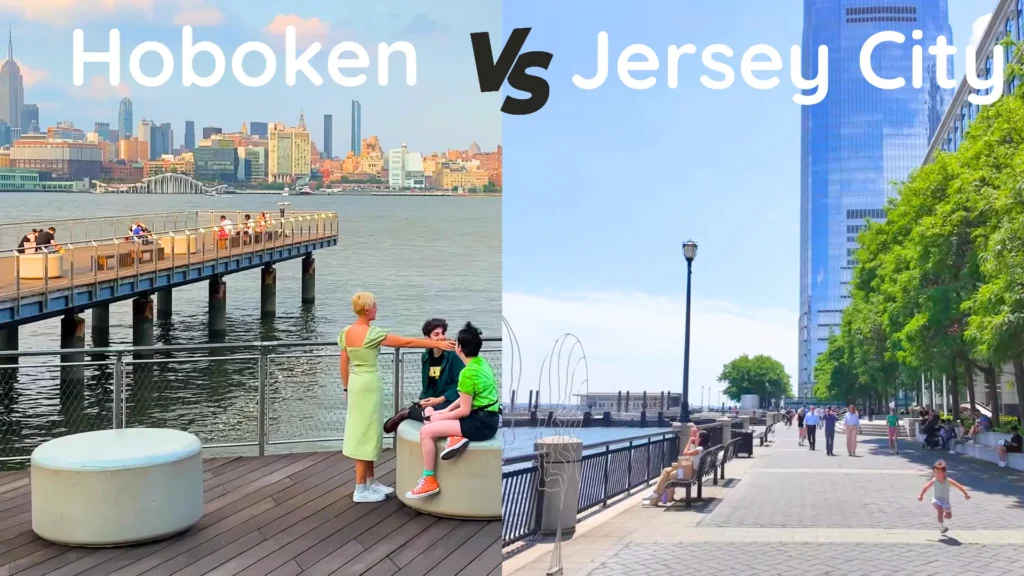
You want to live on the Hudson River.
You want the Manhattan skyline in your window and a commute that takes less than 20 minutes.
Now you just have to pick a zip code.
Hoboken and Jersey City are neighbors. They share the waterfront. They share the PATH train. They both have incredible food scenes. But they are entirely different cities once you actually live there.
If you are deciding between these two, you need to know what you are paying for. You need to know how the daily grind actually feels.
If you eventually decide you want a backyard and a slower pace, you can always read our master guide to the best nj towns near nyc or check out our comparison of Maplewood NJ and Montclair. But if you want to stay in the city, here is the honest, unfiltered breakdown.
The Core Difference: Mile Square vs. Patchwork City
Before we get into rent prices and train schedules, you need to understand the geography. It dictates everything about how you will live.
Hoboken is exactly 1 square mile. Locals call it the Mile Square City. You can walk from the southern border to the northern border in about 25 minutes. Because it is so small, everything is accessible on foot. You do not need a car. You barely need a bicycle.
Jersey City covers 14.5 square miles. It is the second-largest city in New Jersey. It is a patchwork of distinct neighborhoods, each with its own vibe and its own transportation quirks. Downtown Jersey City feels nothing like the West Side. Journal Square feels nothing like Paulus Hook.
If you want a contained, walkable bubble, Hoboken is the answer. If you want variety, space, and a city that feels like it is constantly evolving, Jersey City wins.
The Commute: PATH Trains, Ferries, and Buses
The main reason you are looking at these two cities is the commute. Both offer the best access to Manhattan in New Jersey.
The PATH Train
The Port Authority Trans-Hudson (PATH) train is the lifeline here. You can view the exact schedules on the PATH website.
Hoboken PATH:
You have one main station in Hoboken. It sits right in the center of town.
The train goes two directions. If you take the train toward 33rd Street, you will hit Christopher Street, 9th Street, 14th Street, 23rd Street, and finally 33rd Street. That trip takes about 15 to 20 minutes.
If you take the train toward the World Trade Center, it stops at Newport and Exchange Place before terminating at WTC. That trip takes exactly 11 minutes.
The downside? The Hoboken PATH station is the terminus. You will almost always get a seat if you board during rush hour because the train is starting its route. But the station gets incredibly crowded.
Jersey City PATH:
Jersey City has four PATH stations: Newport, Exchange Place, Grove Street, and Journal Square.
The 33rd Street line runs through Journal Square, Grove Street, Newport, and then into Manhattan.
The World Trade Center line runs through Journal Square, Grove Street, Newport, Exchange Place, and then into WTC.
Because Jersey City has multiple stops, you can choose which neighborhood to live in based on your office location. If you work in Midtown, aim for Grove Street or Journal Square. If you work in the Financial District, aim for Exchange Place or Newport.
The NY Waterway Ferry
The ferry is the most expensive way to commute, but it is also the most pleasant. You can check routes and pricing on the NY Waterway site.
Hoboken Ferry:
You have terminals at Hoboken Terminal (NJ Transit) and at 14th Street (Uptown). The ferry gets you to Midtown (39th Street) or Downtown (Brookfield Place) in about 10 minutes. You get a seat, you can buy a coffee, and you watch the skyline go by. A monthly pass will cost you significantly more than the PATH, but many professionals think the stress reduction is worth the premium.
Jersey City Ferry:
Jersey City has terminals at Paulus Hook and Port Liberté. The Paulus Hook terminal is a lifesaver for people living in the Exchange Place area. It gets you to Midtown in about 12 minutes.
The Hudson-Bergen Light Rail
If you live in Jersey City, the Light Rail is a massive asset. It runs along the waterfront and connects to Liberty State Park, Bayonne, and North Bergen.
If you live in Hoboken, you have two Light Rail stops (Hoboken Terminal and 2nd Street). However, the Light Rail is mostly useful for getting to other parts of Jersey City or to Liberty State Park. It is not a fast way to get into Manhattan.
Driving and Buses
If you plan to drive into the city, you need to factor in the tolls for the Holland Tunnel or the Lincoln Tunnel. The tolls are expensive, and the traffic during rush hour is brutal.
If you want to take a bus, NJ Transit runs extensive routes from both cities into Port Authority Bus Terminal. The buses from Jersey City (specifically Journal Square and The Heights) are frequent and heavily used.
Cost of Living: Rent and Buying
This is where the two cities split dramatically.
The Rental Market
Hoboken:
You are paying for scarcity. There is almost no new land to build on in Hoboken. The rental market is dominated by older brownstones, walk-ups, and a handful of luxury waterfront buildings.
According to RentCafe, the average rent for an apartment in Hoboken is over $3,800 a month. A decent 1-bedroom walk-up will easily cost you $2,500 to $3,000. A 2-bedroom with a washer and dryer will push past $4,000.
You will also likely have to pay a broker fee (usually one month’s rent) and a hefty security deposit. Parking is a separate nightmare and cost.
Jersey City:
Because Jersey City is so much larger, there is a vast variety of housing stock.
You have luxury high-rises in Downtown and Newport. You have historic brownstones in Van Vorst Park. You have older, more affordable apartments in The Heights and Journal Square.
The average rent in Jersey City sits closer to $3,200 a month, according to Zumper.
If you want a brand-new luxury building with a doorman, a gym, and a pool, Jersey City offers much more inventory than Hoboken, often at a lower price per square foot.
Buying a Home
If you are looking to buy, the same rules apply.
In Hoboken, you are buying a piece of history. A brownstone or a condo will cost you a premium. The market is highly competitive.
In Jersey City, you can buy a condo in a new high-rise, a historic townhouse, or a multi-family home. Your budget stretches further the further you move away from the waterfront.
Neighborhood Breakdown: Hoboken
Because Hoboken is so small, the neighborhoods are defined by their elevation and their distance from the PATH station.
Downtown Hoboken (South of 4th Street)
This is the heart of the action. You are closest to the PATH station, the ferry terminal, and Washington Street. It is the most expensive part of town. If you want to roll out of bed and be on a train in 5 minutes, this is the spot. It is also the loudest part of town on Friday and Saturday nights.
Midtown Hoboken (Between 4th and 8th Streets)
This is the sweet spot for many young professionals. You are close enough to walk to the PATH, but far enough away to escape the late-night bar noise. The housing is a mix of older brownstones and mid-rise condos.
Uptown Hoboken (North of 8th Street)
Uptown is quieter and slightly more residential. It has its own commercial strip on Washington Street with great coffee shops and restaurants. You have the 14th Street ferry terminal here, which is a huge plus. It is popular with families and people who want a bit more peace and quiet.
Castle Point
This is the area around Stevens Institute of Technology. The streets are steep, the houses are massive, and the views of the skyline are incredible. It is a historic and very expensive pocket of town.
Neighborhood Breakdown: Jersey City
Jersey City is a collection of distinct villages. You need to pick the one that fits your lifestyle.
Paulus Hook
This is the most historic neighborhood in Jersey City. It is a quiet, cobblestone area right on the waterfront. It is incredibly expensive, but the ferry terminal is right there, making the commute incredibly fast. It is very family-friendly.
Exchange Place and Newport
This is the “Gold Coast.” It is full of glass high-rises, corporate offices, and luxury amenities. It feels like a mini-Manhattan. It is great for young professionals who want a doorman, a gym, and a view. It can feel a bit sterile compared to other neighborhoods.
Grove Street
This is the beating heart of downtown Jersey City. It has a historic, brownstone feel mixed with modern developments. The Grove Street PATH station is the busiest in the city. It is incredibly walkable, with a massive concentration of bars, restaurants, and shops along Newark Avenue.
Hamilton Park and Van Vorst Park
These are two historic parks surrounded by beautiful, 19th-century brownstones. These neighborhoods are quiet, leafy, and highly sought after by families. The commute to the PATH is a 5 to 10-minute walk.
The Heights
The Heights sits on the cliffs above Hoboken. It is a more affordable, working-class neighborhood that is rapidly gentrifying. It has a fantastic food scene along Central Avenue. The commute to Manhattan relies heavily on buses or the Light Rail, as it is a long walk to the PATH.
Journal Square
This is the transit hub of Jersey City. It is gritty, diverse, and incredibly busy. The PATH trains start here, so you always get a seat. The rent is cheaper, but it is a far cry from the waterfront lifestyle.
Food and Drink: Washington Street vs. Newark Avenue
Both cities have phenomenal food scenes. You will not go hungry.
Hoboken
The food scene in Hoboken is centered on Washington Street. You have everything from legendary pizza slices at Benny Tudino’s to high-end Italian at Augustino’s.
You have the famous Carlo’s Bakery (yes, from the TV show). You have classic spots like Fiore’s Deli for a legendary mutz sandwich.
The bar scene is heavily concentrated on Washington Street between 1st and 4th Streets. It is young, loud, and busy, especially on weekends.
Jersey City
The food scene here is arguably more diverse and exciting right now.
Newark Avenue is the main artery, featuring the Newark Avenue Pedestrian Plaza. You can find incredible Filipino food, authentic ramen, and high-end Italian (like Razza, which is famous for its pizza).
The bar scene is spread out. You can grab a craft cocktail at Cellar 335 or a beer at Departed Soles Brewing. It feels slightly more grown-up than the Hoboken bar scene.
Families and Schools
If you are moving with children, the choice gets more complicated.
Hoboken Schools
Hoboken has a strong sense of community for families. The waterfront parks (Pier A, Sinatra Park) are fantastic for kids.
The public school district is small. You can check the current ratings on GreatSchools. Because of capacity issues and space constraints, many families in Hoboken apply for charter schools or opt for private education. The Hoboken Dual Language Charter School (HoLa) is highly sought after.
Jersey City Schools
Jersey City has a massive public school system. The quality varies dramatically from neighborhood to neighborhood.
Downtown schools (like PS 16 and PS 8) are generally well-regarded. McNair Academic High School is one of the best public high schools in the entire state.
However, the sheer size of the district means you have to do your research carefully based on your specific address.
Parking and Car Ownership
Do you need a car?
In Hoboken, the answer is almost always no. Parking is a nightmare. The streets are narrow. Unless you are paying $300 to $400 a month for a garage spot, you will spend hours circling for street parking. The town is so walkable that a car is often more of a burden than a benefit. If you need a car, look into the Hoboken parking permits and understand the rules before you sign a lease.
In Jersey City, the answer depends on your neighborhood. If you live in Downtown, Grove Street, or Newport, you do not need a car. The PATH and Light Rail are enough.
If you live in The Heights or on the West Side, a car is highly recommended. Parking is still tough, but the neighborhoods are more spread out.
The Reality of the “Small Town” Feel
People move to Hoboken because they want to feel like they live in a small town, but with a 10-minute commute to the greatest city in the world.
That small-town feel is real. You will run into your neighbors. You will see the same dogs being walked every morning. The community is tight-knit.
But it comes with a trade-off. The small-town feel means everyone knows your business. It means the bars are crowded. It means the streets are loud on a Saturday night.
Jersey City does not pretend to be a small town. It is a big city. It has 14.5 square miles of grit, beauty, and variety. You can find a quiet block in Van Vorst Park or a bustling street in Journal Square. It offers anonymity if you want it, and community if you seek it out.
Pros and Cons of Living in Hoboken
Pros
- Incredibly walkable. You can do everything on foot.
- The commute is world-class (PATH or Ferry).
- The historic architecture and brownstones are beautiful.
- The community feel is genuine.
Cons
- It is incredibly expensive.
- The bar scene can be loud and obnoxious.
- Parking is a nightmare.
- The public school district is small and highly competitive.
Pros and Cons of Living in Jersey City
Pros
- You get more space for your money.
- There are diverse neighborhoods for every lifestyle.
- The food scene is more diverse.
- There are more transit options (PATH, Ferry, Light Rail, Buses).
- The public school system has excellent magnet programs.
Cons
- It can feel less cohesive than Hoboken.
- Some neighborhoods are still developing.
- The commute from areas like The Heights can be slower.
Conclusion
You aren’t going to make a bad choice here. Both towns are fantastic.
Hoboken gives you the ultimate urban village experience. It is a 1-square-mile bubble of history, bars, and easy commutes. If you want everything within a 15-minute walk, pick Hoboken.
Jersey City gives you a real city experience. It gives you space, variety, and a slightly lower price tag. If you want to spread out, explore different neighborhoods, and get more apartment for your money, pick Jersey City.
If you want to see how these two compare to towns with backyards and top-tier schools, go back to our master list of nj towns near nyc. It has the data you need to widen your search.
FAQ
Is Hoboken or Jersey City better for commuting?
They are tied. Hoboken has the edge if you work in the Financial District (WTC is 11 minutes away via PATH). Jersey City has multiple PATH stations and ferry terminals, making it more flexible depending on exactly where you live.
Is Hoboken cheaper than Jersey City?
No. Hoboken is generally more expensive than Jersey City. Because Hoboken is only 1 square mile, the real estate is incredibly limited. You get more square footage for your money in Jersey City.
What is the cost of living in Hoboken NJ?
It is high. The average rent for a 1-bedroom apartment in Hoboken is over $3,800 a month. You are paying a premium for the historic charm and the ultra-short commute.
Is Hoboken NJ a good place to live?
Yes. It is highly rated for its walkability, safety, and dining scene. It is a great place for young professionals. For families, it is also great, though housing costs and school capacity can be challenging.
What is the difference between Hoboken and Jersey City?
Hoboken is a small, 1-square-mile city with a historic, tight-knit feel. Jersey City is much larger, with distinct neighborhoods, more space, and newer high-rise developments.
Do I need a car in Hoboken or Jersey City?
In most parts of both cities, a car is a burden. Parking is expensive and scarce. The PATH, ferry, and Light Rail are usually faster. However, if you live in the outer neighborhoods of Jersey City (like The Heights), a car is helpful.
What are the best neighborhoods in Jersey City for families?
Hamilton Park, Van Vorst Park, and Paulus Hook are excellent for families. They have quiet streets, access to parks, and are close to the PATH or ferry.
What are the best neighborhoods in Hoboken?
Downtown is best for nightlife and commuting. Uptown is better for families and quiet living. Midtown offers a good balance of both.
How long does it take to get from Hoboken to NYC?
The PATH train takes 11 minutes to the World Trade Center and about 15 to 20 minutes to 33rd Street. The ferry takes about 10 minutes to Midtown.
How long does it take to get from Jersey City to NYC?
It depends on your station. The PATH from Grove Street to 33rd Street takes about 20 minutes. The ferry from Paulus Hook to Midtown takes about 12 minutes.
Are the schools in Hoboken good?
The public schools are decent, but the district is small. Many families opt for charter schools (like HoLa) or private schools.
Are the schools in Jersey City good?
The district is large and the quality varies. Downtown schools are highly rated, and McNair Academic High School is one of the best in the state. You have to research specific neighborhoods to get the best schools.
What is the nightlife like in Hoboken vs Jersey City?
Hoboken has a more concentrated, high-energy bar scene along Washington Street. Jersey City has a more spread-out, diverse scene with great cocktail bars and breweries.
Is it better to rent or buy in Hoboken?
Given the high prices, renting is often the only option for new arrivals. Buying a brownstone or condo requires a massive budget and willingness to enter a highly competitive market.
Is it better to rent or buy in Jersey City?
Jersey City offers more inventory for buyers. You can find condos and townhouses at various price points depending on the neighborhood. Rent is also slightly cheaper than Hoboken.