
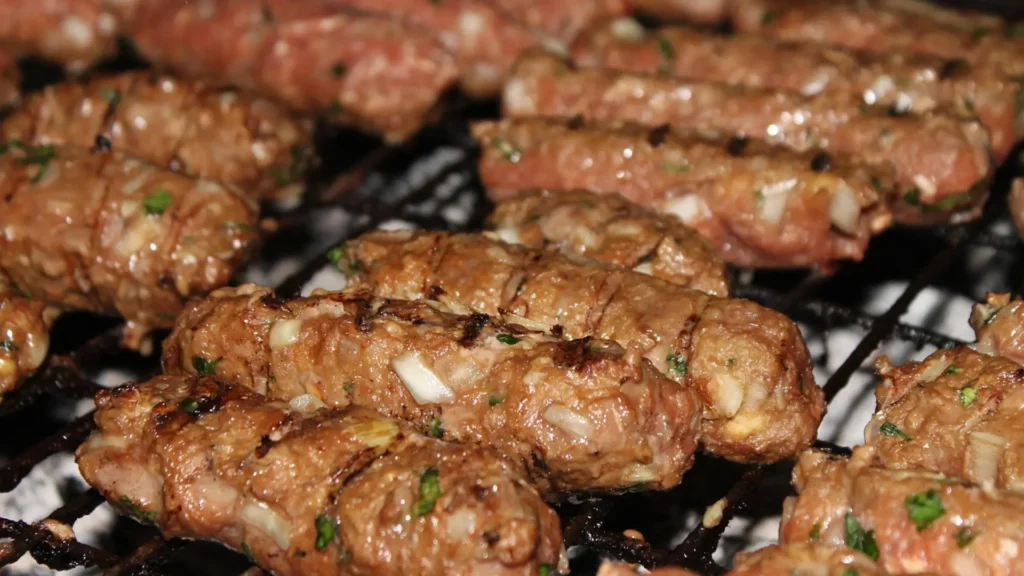
Belgrade food is grilled, baked and generous. Expect pork, beef, cheese, cabbage and bread at almost every table, and portions that make a second course look optional.
Twelve dishes cover what a first visit needs, and a river-fish specialty in Zemun rounds out the list. Each one below comes with a place that public guides recommend, a note on what to order and a rough price where I found one.
I haven’t eaten at any of these places. The picks come from guides, and I say which kind of source I’m relying on. Restaurants close and change hands, so check hours and menus before you go.
Prices come from one 2026 guide and a few older reviews, so treat them as a ballpark.
Belgrade food at a glance
| Dish | What it is | Where guides send you |
|---|---|---|
| Burek | Flaky pastry filled with meat or cheese | Pekara Trpković |
| Ćevapi | Small grilled minced-meat sausages in flatbread | Savčić and Cica |
| Pljeskavica | A large grilled patty | Grill houses like Savčić |
| Karađorđeva šnicla | A breaded cutlet rolled around kajmak | Bela Reka |
| Sarma | Cabbage rolls with meat and rice | Kafana Suvobor |
| Gibanica | A cheese and egg pie | Bakeries |
| Kajmak and ajvar | A creamy dairy spread and a pepper spread | On the side almost everywhere |
| Beans (pasulj and prebranac) | Bean stew and baked beans | Kafanas |
| Shopska salad | Tomato, cucumber, onion and white cheese | Almost every menu |
| Svadbarski kupus | Slow-cooked cabbage with meat | Kafana Suvobor |
| Cracklings and smoked meats | Pork snacks served as starters | Kafanas |
| Rakija | Fruit brandy | Skadarlija taverns and kafanas |
| Riblja čorba | Spicy fish soup | The Zemun quay |
How eating works in Belgrade
Four kinds of places cover most meals, and knowing which is which saves you from ordering badly.
A pekara is a bakery. It sells burek, pies and pastries by the slice, often from early morning, and it’s the cheapest way to eat well.
A ćevabdžinica is a grill house. The menu is short, and it centers on ćevapi and pljeskavica with bread, onion and sides.
A kafana is a traditional tavern. It serves long, slow meals of grilled meat, stews and cabbage dishes, and some have live music in the evening.
A restaurant in the modern sense may cook Serbian dishes with a lighter touch, and a kafić is a café where a coffee can last an hour.
Kafana or restaurant?
Pick a kafana when you want an evening to unfold. Meals run long, grilled meat and stews dominate the menu, and some places add live music.
Pick a modern restaurant when you want a lighter plate and a quieter room, or when you’re eating with someone who doesn’t eat much meat.
Pick a grill house when you want a fast, cheap meal. It’s the best value in the city, and it’s over in half an hour.
Portions tend to be large. Order less than you think you need, share the grilled plates and add more later.
Keep some cash. Bakeries and small grill counters are the places most likely to prefer it.
Smoking indoors is still the default in most Belgrade venues, according to a 2026 nightlife guide. If smoke bothers you, ask for a table on the terrace or a smoke-free room before you sit down.
Where Belgrade’s food comes from
The menu reads like a map of who ruled the city. Table Journey’s food history says the Ottoman pantry of grilled meat, filo pastry and yogurt sauces became the foundation of the Serbian repertoire.
Zemun tells a different story. It sat in Austria-Hungary while Belgrade across the river stayed Ottoman, so the quay developed Central European bakery, sausage and Danube fish traditions that still anchor the neighborhood.
The kafana tradition is old too. The same source says Kafana Znak pitanja, on Kralja Petra street, opened in 1826, and that the question mark sign went up in 1892. Other sources give a slightly different year, and Dva jelena in Skadarlija followed in 1832.
That mix explains why one table can hold burek, grilled sausages, cabbage rolls and river fish, and why the city’s cooking never settles into a single style.
The 12 dishes
1. Burek
Burek is thin pastry coiled around a filling and baked in a big round tray. It arrived with the Ottomans centuries ago, and it’s the breakfast people recommend first.
In most Belgrade bakeries, burek means the meat version. Cheese is usually sirnica and spinach is zeljanica, so ask before you point.
Drink it with plain yogurt, the local way. The pairing sounds odd and it works.
Pekara Trpković on Nemanjina street is the name guides mention first. It reportedly runs around the clock and has been baking for over 100 years.
One 2026 guide puts a burek at roughly RSD 150 to 300, which is about €1.30 to €2.60. That’s the cheapest filling meal in the city.
How to order: ask for “burek sa mesom” (with meat) or “sirnica” (cheese), and add “jogurt” for the drink. A slice is enough for breakfast, and a second one turns into lunch.
2. Ćevapi
Ćevapi are small, finger-sized sausages of minced meat, grilled over charcoal. They come in flatbread (lepinja) with chopped raw onion, ajvar and often kajmak.
Order by the piece. Portions of 5 or 10 are common, and 10 is a lot of food for one person.
One guide recommends Ćevabdžinica Savčić in Vračar. Guides also point to Ćevabdžinica Cica, which has branches near Knez Mihailova and on the Zemun riverside.
Don’t fill up on the bread. The meat and the kajmak are the point.
How to order: say the number of pieces and ask for them “u lepinji” (in flatbread) with “kajmak” and “luk” (onion). Most counters will add ajvar if you ask.
3. Pljeskavica
Pljeskavica is the larger cousin of ćevapi. It’s a flat, wide patty of minced meat, grilled and served with the same bread, onion and spreads.
Pick it when you want a single big patty. Many grill houses sell both, and Savčić is a good place to compare them.
A casual grill plate runs about RSD 600 to 900, or roughly €5 to €8, according to one 2026 guide. That’s a full meal.
How to order: ask for a “pljeskavica” with the sides you want, and say “bez luka” if you’d rather skip the raw onion.
4. Karađorđeva šnicla
Karađorđeva šnicla is a Belgrade invention: a thin pork or veal cutlet rolled around kajmak, breaded and fried. It’s rich, and one plate can feed two light eaters.
A food guide recommends Bela Reka for it. Kafana Suvobor, which Gault&Millau reviewed in 2026, lists a Karađorđe steak on its menu as well.
Order it for dinner, and skip the starters. A tomato salad on the side cuts through the richness.
How to order: ask for “Karađorđeva šnicla” and share one plate between two if you’re also having a salad. Some kitchens serve it with tartar sauce and fries.
5. Sarma
Sarma is minced meat and rice rolled in soured cabbage leaves and cooked slowly, often with smoked meat. It’s winter comfort food, and it’s considered proper Serbian home cooking.
Kafana Suvobor’s menu includes sarma, according to the same Gault&Millau review. Old-school kafanas are the best bet, since sarma suits a slow kitchen.
Eat it with bread and a spoonful of sour cream if it’s offered. It reheats well, so it’s a dish that tastes better in a place that cooks big batches.
How to order: ask for “sarma” and check whether it comes as two or three rolls, since the plate sizes vary.
6. Gibanica
Gibanica is a cheese and egg pie made with layers of thin pastry. It shows up as a starter, a snack or a bakery breakfast.
Try it fresh from a pekara. A slice with yogurt makes a cheap lunch, and it’s one of the few filling dishes that works for vegetarians.
Heavy cheese pies sit like a stone, so don’t order one right before the grill.
How to order: ask for a slice of “gibanica” at the counter, and add yogurt if you want the classic pairing.
7. Kajmak and ajvar
These two are on almost every table. Kajmak is a soft, creamy dairy spread with roughly 60% milk fat, and ajvar is a roasted red pepper spread.
Put kajmak on hot grilled meat, where it melts, or on warm bread. Ajvar goes with grilled dishes, and some kafanas serve it with cheese.
If you take food home, jars of ajvar travel well. Kajmak is fresher and perishable, so eat it in Belgrade.
How to order: ask for “kajmak” and “ajvar” as sides, and expect them to be charged separately in some places.
8. Pasulj and prebranac
Pasulj is a hearty bean stew, usually cooked with smoked meat. Prebranac is baked beans, often with onions and paprika.
Both suit a cold day in a kafana. Kafana Suvobor’s review lists stewed beans, and kafanas generally keep a pot going.
Vegetarians should ask. Pasulj is often cooked with meat, and prebranac can be made without it. “Bez mesa” means without meat.
How to order: ask “da li ima mesa?” (is there meat in it?) before you commit.
9. Shopska salad
Shopska is a simple salad of tomato, cucumber, onion and pepper, topped with grated white cheese. It’s on almost every menu.
Order it with grilled meat. The acid and the cheese balance the fat, and it’s the lightest thing on the table.
In summer, it’s often the best dish in the room because the tomatoes taste like tomatoes.
How to order: ask for “šopska salata” and share one between two people.
10. Svadbarski kupus
Svadbarski kupus means wedding cabbage. It’s sour cabbage slowly cooked with meat, and it’s a dish for special occasions.
You’ll find it on kafana menus, and Gault&Millau lists it at Kafana Suvobor. It tastes better on a cold day, and it’s a good choice if you’ve had enough grilled meat.
Order it when you want to eat something traditional that isn’t on every tourist menu.
11. Cracklings and smoked meats
Kafanas serve pork snacks as starters. Cracklings (čvarci) are crisp pork rinds, and smoked sausages and cured meats come on a board.
They’re salty and fatty, and they pair with rakija. A shared plate is plenty for a table.
Ask what’s house-made. A kafana that smokes its own meat is usually proud of it.
12. Rakija
Rakija is fruit brandy, and šljivovica, made from plums, is the best known. Many places serve it as an aperitif, and a glass before a meal is normal.
The full drinks guide sits further down, with the types, the beer, the wine and the coffee.
A sweet finish
For dessert, look for pancakes (palačinke) and fruit-filled dumplings. A bakery or a café on Knez Mihailova is an easy place for a coffee and a slice of cake.
Skip dessert at the end of a big grill meal. Come back for it the next afternoon.
Menu words you’ll see
A few words will get you through most menus. They’re printed in Latin and Cyrillic letters, so learn both shapes if you can.
| Serbian | English |
|---|---|
| Predjelo | Starter |
| Glavno jelo | Main course |
| Roštilj | Grill, or mixed grilled meat |
| Svinjetina | Pork |
| Junetina | Beef |
| Piletina | Chicken |
| Jagnjetina | Lamb |
| Riba | Fish |
| Čorba or supa | Soup |
| Salata | Salad |
| Hleb | Bread |
| Sir | Cheese |
| Poslastice | Desserts |
| Bez mesa | Without meat |
At the counter of a grill house, you can point and say the number of pieces you want, and “molim” (please) does the rest.
Menus and signs use both Latin and Cyrillic letters. Many menus in the center carry English too, though the small grill counters may not. A phone camera with a translation app solves most of it.
How to order at a grill house
Grill houses run fast, and the system is simple once you’ve seen it.
You stand at the counter or sit at a table, and you say the dish and the number of pieces. A common order is “deset ćevapa” (ten ćevapi) with lepinja, kajmak and onion.
Sides are extra in many places, so ask for what you want. Your drink comes separately, and a bottle of yogurt or a beer is the usual match.
Pay at the counter or when you leave, depending on the place. If you’re unsure, ask “gde se plaća?” (where do I pay?).
Plan for about 20 to 30 minutes. A grill house is a quick meal, and the food comes hot.
Where to eat, by situation
Skadarlija
Skadarlija is the bohemian quarter, often compared to Montmartre in Paris. Tri šešira dates to 1864 and is the oldest working kafana on the street, and Dva jelena claims roots back to 1832.
Expect traditional food, a live musician at your table and a bill higher than elsewhere in the city. It’s touristy, and it makes for a good evening once.
Book ahead on weekends. My list of 14 things to do in Belgrade covers the street in more detail.
Old-school kafanas
Znak pitanja, whose name means question mark, is described by one travel guide as the oldest kafana in Belgrade, and I cover it below. Kafana Suvobor, on Kralja Petra street, earned a Gault&Millau review in 2026 for dishes like ćevapi, Karađorđe steak, stewed beans, sarma and svadbarski kupus.
A kafana guide from The Nutshell Times explains the culture well. Treat any single list as a start and ask a local which one is busy.
Kralja Petra street: a food walk
Kralja Petra street runs through the old Kosančićev Venac quarter, near the cathedral and the fortress end of town, and it holds more of the places guides name than any other street I found.
Znak pitanja sits at number 6, Manufaktura at 13 to 15, Kafeterija Magazin 1907 at 16 and Kafana Suvobor at 70. Smokvica, a Mediterranean café, is listed at number 73.
That makes it a good walk between sights. Start with coffee or brunch at the top end, eat a kafana lunch in the middle and finish with a drink near the fortress. It fits the first day of my 3-day Belgrade itinerary, when you’re walking from Knez Mihailova toward Kalemegdan.
Check hours before you go, because they change by season and by day.
Places guides keep naming
These traditional places came up most often in the guides I read, along with what each source says. I haven’t eaten at any of them.
Znak pitanja (Kralja Petra 6) is described as the oldest tavern still operating in Belgrade, in a building nearly 200 years old. Sources disagree on the date: Gault&Millau says 1823, Table Journey says 1826 and In Your Pocket says the 1820s.
In Your Pocket adds that the language reformer Vuk Karadžić dined there. Table Journey lists ćevapi, pljeskavica and sarma, with šljivovica to drink.
Manufaktura (Kralja Petra 13 to 15) serves traditional Serbian food with regional cheeses and Mangalica pork, a rich meat from a woolly pig breed. Table Journey lists ćevapi, a Mangalica platter and homemade cherry iced tea, a large garden and opening hours of 09:00 to 24:00 on Sunday to Thursday and to 01:00 on Friday and Saturday.
Stara Hercegovina (on Carigradska street) cooks Herzegovinian lamb and a mixed Serbian grill. Table Journey lists three dining halls and a 130-seat summer garden, with opening hours of noon to midnight every day. One diaspora guide says older Belgraders call it a place where you could eat well “since forever.”
Ima Dana (on Skadarska, in Skadarlija) has tamburica music every night, according to Table Journey, along with poetry evenings and traditional classics. It lists the kafana as opened in 1969.
Proleće is known for home-cooked meals and grilled meats, says In Your Pocket.
Treat these as starting points. Menus, prices and hours change, and one list can’t judge a kitchen.
Modern Serbian cooking
For Serbian staples with a creative twist, one food writer points to Homa in lower Dorćol. One guide from Culture Trip also lists Ambar, which cooks Balkan dishes with a modern approach, and Table Journey lists Iva in Vračar, a modern Balkan kitchen it says carries a Michelin Bib Gourmand.
These cost more than a grill house. They suit a dinner when you’ve had your fill of kafanas.
The Danube quays in Zemun
Zemun’s quay is where Belgraders go for river fish. Lonely Planet says the restaurants along the promenade serve river-fish dishes and spicy riblja čorba, a fish broth, and that they’re known for live music and a lively evening crowd.
Table Journey lists Šaran as Belgrade’s oldest fish house, founded by a fisherman over a century ago on the Zemun quay, with a fishermen’s soup recipe it still pours. Restoran Reka, on the same stretch of quay, is listed with a Danube terrace and live music.
Order the fish soup first and the pan-fried carp second. River fish costs more than grilled meat, because good freshwater fish isn’t cheap, so budget accordingly.
If fish isn’t your thing, Lonely Planet also mentions grills at Naja, steaks at Toro and home-cooked food at Ćiribu Ćiriba.
Book a terrace table for sunset, and expect the music to start in the evening. My 3-day itinerary puts Zemun on Day 3, which makes it the natural place for a long late lunch.
Coffee and brunch in the old town
For a sit-down coffee or a late breakfast, Table Journey lists Kafeterija Magazin 1907 at Kralja Petra 16, a five-story Art Nouveau building serving specialty coffee, brunch boards and small plates. It’s open from 07:00 on weekdays and 08:00 on weekends, according to the listing.
An older Nutshell Times guide says Znak pitanja serves Turkish coffee with Turkish delight in a traditional set. That guide is from 2011, so confirm that it still does.
Grill houses and bakeries
For ćevapi and pljeskavica, the names to know are Ćevabdžinica Savčić in Vračar and Ćevabdžinica Cica. For burek and bakery food, Pekara Trpković is the one guides mention first.
My 3-day Belgrade itinerary puts a Vračar lunch next to Saint Sava and the Tesla Museum, which is where Savčić sits.
A cheat sheet of the places above
| Place | Best for | Worth knowing |
|---|---|---|
| Pekara Trpković | Burek and an early or late snack | Reportedly open around the clock |
| Ćevabdžinica Savčić | Ćevapi and pljeskavica in Vračar | Near Saint Sava and the Tesla Museum |
| Ćevabdžinica Cica | Ćevapi near Knez Mihailova or in Zemun | Casual and quick |
| Bela Reka | Karađorđeva šnicla | A food guide’s pick for the dish |
| Znak pitanja | History, a kafana meal, Turkish coffee | Kralja Petra 6, oldest tavern still operating |
| Manufaktura | Traditional food in a garden | Kralja Petra 13 to 15, open late on weekends |
| Kafana Suvobor | Kafana classics | Kralja Petra 70, reviewed by Gault&Millau in 2026 |
| Stara Hercegovina | Herzegovinian lamb and mixed grill | Big summer garden, open noon to midnight |
| Ima Dana | Skadarlija with live music | Tamburica music nightly |
| Tri šešira and Dva jelena | Skadarlija atmosphere | Book ahead on weekends |
| Šaran and Reka | River fish on the Zemun quay | Book a terrace for sunset |
| Homa, Iva and Ambar | Modern Serbian and Balkan cooking | More expensive than grill houses |
| Radost Fina Kuhinjica, Rai Urban Vege, VegANGELov | Vegetarian and vegan meals | Check recent reviews |
Booking and timing
Only a few places need a reservation. Skadarlija on weekend evenings is the main one, and a sunset terrace on the Zemun quay is the other.
For everything else, turn up. Grill houses and bakeries don’t take bookings, and most kafanas have room on a weekday.
Opening hours vary. The listings I read show Manufaktura open from 09:00, Stara Hercegovina from noon and Kafeterija Magazin 1907 from 07:00 on weekdays. Check the day you plan to go.
Eating by neighborhood
Each kind of meal has a district.
The old center (Knez Mihailova and around) is for coffee, cake and a light lunch. It’s handy between sights, and it’s where the tourist crowds sit.
Skadarlija is for a long dinner with live music, once.
Dorćol has modern Serbian cooking, a vegan restaurant and the bars of Strahinjića Bana. It’s the best district for a relaxed dinner away from the tourist street.
Vračar is the grill-house district, with Savčić near Saint Sava and the Tesla Museum, and Iva for a modern dinner.
Zemun is for river fish and long evenings on the quay.
Where to eat near the main sights
These food stops sit next to the sights in my itinerary.
| Near | Try |
|---|---|
| Republic Square and Knez Mihailova | A café stop, a bakery slice or a light lunch |
| Belgrade Fortress | A bakery or café in the old center before or after |
| Skadarlija | A kafana dinner, booked ahead on weekends |
| Saint Sava and the Tesla Museum | Ćevapi at Savčić in Vračar |
| Strahinjića Bana in Dorćol | A modern Serbian dinner, then a drink |
| Zemun | River fish on the quay |
Street food and late nights
Bakeries open early and sell burek by the slice. Grill counters and stands sell pljeskavica and ćevapi to take away.
Late at night, Pekara Trpković reportedly runs around the clock, which makes it the easy stop after a bar. Several guides also list grill counters that stay open late near the nightlife areas.
Ask your host which ones near your hotel are open when you want them. Hours change, and a closed counter at 1 a.m. is no fun.
What to drink
Drinks are half of eating in Belgrade, and the national list is short.
Rakija
Rakija is Serbia’s national drink. The base fruit changes the name: šljivovica is plum, lozovača is grape, kajsijevača is apricot, dunjevača is quince and viljamovka is pear. One guide says šljivovica makes up roughly 70% of production.
Homemade rakija is common, and a host may offer you a glass. Sip it, and say “živeli” with eye contact when you clink. Rakija bars are also opening in Belgrade, and some bartenders now use it in cocktails.
Beer
Jelen and Lav are the two big local lagers. One guide says Jelen is brewed on the Danube at Apatin and holds roughly 40% of the market, with a bottle running RSD 90 to 150 in a shop and RSD 150 to 250 in a café.
Craft beer began to grow after 2010, mostly in Belgrade, and costs about double in specialist bars. Zaječarsko and Jagodinsko are two other lagers you’ll see.
Wine
Serbia has five main wine regions: Fruška Gora, Vršac, Oplenac, Smederevo and Župa, according to one city guide. Bermet, the aromatic dessert wine from Sremski Karlovci, is the local specialty, and my Novi Sad guide covers the town.
Serbia.travel also says Belgrade has its own small wine region, with vineyards on the Danube banks and the slopes of Kosmaj and Avala.
Try a špricer, a white wine mixed with soda water. It’s as refreshing as beer on a hot day.
Coffee
Turkish coffee, called domaća kafa, is brewed in a small copper pot (džezva) until foam forms. You’ll find tons of cafés and terraces, and Serbian coffee can be strong, so go easy on your first cup.
Sit down for it. A coffee is a reason to stay for an hour, and the waiter won’t hurry you.
Vegetarian, vegan and halal
Belgrade is easier for vegetarians than it used to be, and it still leans on meat.
Vegetarian. Bakery pies (sirnica and zeljanica), shopska salad, gibanica and prebranac cover the basics. Always ask about meat in stews and beans.
Culture Trip lists vegetarian restaurants including Radost Fina Kuhinjica and Rai Urban Vege. HappyCow is worth checking before you pick a place.
Vegan. Table Journey’s dietary guide lists VegANGELov in Dorćol, and Culture Trip and In Your Pocket both run vegan lists. Check them before you go, because the scene changes fast.
Halal. One 2026 guide says official halal restaurants exist in Belgrade, and that they’re limited. I haven’t found a reliable list, so ask your hotel and check recent reviews.
Telling a kitchen about allergies
Serbian kitchens use a lot of dairy, bread, nuts and pork, so allergies need a clear request.
Say “alergičan sam na” (I’m allergic to) if you’re a man, or “alergična sam na” if you’re a woman, then name the food. For example, “orašasti plodovi” is nuts and “mleko” is milk.
Write it on your phone in Latin and Cyrillic if you can. A staff member can show it to the kitchen without a misunderstanding.
Ask before you order. Many dishes arrive pre-mixed, and a kitchen can’t remove an ingredient from a stew.
Useful phrases at the table
A few phrases make eating out smoother, and staff tend to warm up when you try.
“Šta preporučujete?” means what do you recommend. “Šta je specijalitet kuće?” asks for the house specialty, and it’s a good way to find the dish the kitchen is proud of.
“Račun, molim” means the bill, please. “Još jedno pivo, molim” is one more beer, please, and “voda, molim” gets you water.
“Prijatno” is what a waiter or a neighbor says when your plate arrives, and it means enjoy your meal. A “hvala” back goes a long way.
Say “živeli” when you clink glasses. It means cheers, and you make eye contact as you do.
What it costs
Belgrade is cheap by Western European standards, and bakeries and grill houses are the budget end.
One 2026 guide puts a casual grill plate at about RSD 600 to 900, and a bakery burek at roughly RSD 150 to 300. At around 117 dinars to the euro, that’s €5 to €8 and about €1.30 to €2.60.
A day of bakery breakfast and a grill lunch comes to roughly RSD 750 to 1,200 before dinner. That’s my arithmetic from the two figures, so treat it as a rough number.
Skadarlija and modern restaurants cost more. If you’re watching your budget, make them one meal of the trip.
Eating on three budgets
The budget day. Bakery breakfast, a grill lunch and fruit from a market. With the prices I found, that’s roughly RSD 750 to 1,200 before dinner, plus a few hundred dinars for a snack.
The middle day. Bakery breakfast, a grill lunch and a kafana dinner. Add a modern Serbian restaurant on one of the evenings if you want a change of pace.
The splurge. A modern restaurant, a river-fish dinner on the Zemun quay or a long evening in Skadarlija. These cost the most, and one a trip is plenty.
Mix them. A cheap breakfast and lunch pay for a better dinner.
Paying and tipping
Carry cash for bakeries, stands and small grill counters. Larger restaurants take cards in many cases, and I’d confirm at smaller places.
At sit-down restaurants, one guide says to round up or tip about 10% of the bill. That’s a custom, so use your judgment.
Ask for the bill at the table. A waiter won’t bring it until you do, and a long meal is a courtesy.
Two sample meals and what they cost
Two meals show how the prices add up.
A grill lunch for two. Two casual grill plates at RSD 600 to 900 each come to RSD 1,200 to 1,800. Add two beers at RSD 150 to 250 each, and the total is roughly RSD 1,500 to 2,300, or about €13 to €20.
A bakery breakfast for two. Two burek at RSD 150 to 300 each come to RSD 300 to 600, plus yogurt. That’s about €2.60 to €5, and it’s filling.
Treat these as ballparks, since I built them from two figures in one 2026 guide.
Seasons and what’s on the table
Serbian cooking follows the weather, even if the menus run all year.
Winter is for sarma, svadbarski kupus, bean stews and anything slow-cooked. A kafana with a pot on the stove suits a cold evening.
Summer shifts toward grills, shopska salad and river fish on the quay. Tomatoes taste best in the warm months.
Autumn is the season for preserving. Ajvar is traditionally made in large batches for the winter, so jars of it are everywhere in the fall.
Festivals follow the calendar too. Serbia.travel lists wine and rakija festivals, and many cities hold them in the warmer months, so ask locally what’s on during your dates.
Markets
Belgrade’s green markets are the place to see what locals buy. Culture Trip mentions the Kalenić market, and Lonely Planet lists Zeleni Venac.
Markets like these usually sell fresh produce, cheese, honey and homemade spreads. Go in the morning, when stalls are full, and bring cash.
A market visit pairs well with a bakery breakfast. It costs little, and you’ll see what the dishes above are made from.
Taking food home
Ajvar jars and rakija bottles make good souvenirs. Pack them in your checked bag, wrapped in clothes, because liquids over 100 ml can’t go in a carry-on.
Check your airline’s rules and your destination’s customs limits for alcohol before you buy. Rakija is strong, and some countries limit how much you can bring.
Dry goods like spice mixes and sweets travel without fuss. Fresh cheese and kajmak don’t, so eat those in Belgrade.
Food tours
Several operators run food tours in Belgrade, usually combining grill food, a bakery stop and a rakija tasting. I haven’t taken one.
If you want a tour, compare the stops, the group size and the cancellation terms. Check that your dietary needs are covered before you book.
A tour suits a short visit, since it packs a lot into one afternoon. With more time, eating your own way costs less.
One day of eating in Belgrade
The places above fit into a single day.
Start with burek and yogurt at a bakery. Walk it off along Knez Mihailova, and keep lunch light, since dinner is the big meal.
For a Vračar day, eat ćevapi at Savčić after the Tesla Museum. Finish with a Karađorđeva šnicla at a kafana, or head to Skadarlija for a long evening and a glass of rakija.
If you want a lighter night, try modern Serbian cooking in Dorćol, then a drink on Strahinjića Bana. My itinerary shows how these fit into three days.
Three days of eating
A short stay is easier with a rough plan. This one matches my itinerary.
Day 1. Burek and yogurt for breakfast and a light bakery lunch. Dinner in Skadarlija, booked ahead.
Day 2. Breakfast at Pekara Trpković, then ćevapi at Savčić after the Tesla Museum. Finish with a Karađorđeva šnicla or a modern Serbian dinner in Dorćol.
Day 3. A long late lunch of river fish in Zemun, then a quiet last evening with rakija. Leave room for a final burek on the way to the airport.
Swap days to match your plans. The only fixed point is booking Skadarlija, since weekend evenings fill up.
Mistakes and etiquette
Ordering too much is the classic one. Portions are big, and sharing is normal.
Filling up on bread is the next. The meat and the spreads are the point.
Shooting rakija is a mistake. Sip it, and say “živeli.”
Assuming a stew is vegetarian costs vegetarians a meal. Ask first.
Skipping cash is a small one. Bakeries and stands are the places that prefer it.
Eating every meal in Skadarlija is a trap. Eat there once, then explore other neighborhoods.
Walking into the first place with a waiter outside is an easy way to overpay. A busy counter full of locals is a better sign.
Before you eat: a short checklist
Run through this when you land.
- Decide which meal you want most, whether burek, ćevapi, a kafana dinner or river fish
- Book Skadarlija or a Zemun terrace if you’re going on a weekend
- Carry cash for bakeries and grill counters
- Save the names of two or three places from this list on your phone
- Ask about meat in every stew if you eat vegetarian
- Leave room for a second meal, because portions are big
Conclusion
Belgrade food rewards an appetite and a loose plan. Eat burek for breakfast, grilled meat for lunch and a slow kafana dinner, and add one modern restaurant if you want a change.
If you’re heading north, Novi Sad has its own fish-based cooking, and my Belgrade to Novi Sad guide covers the trip. For more trips across the continent, browse the Europe guides.
Tell me in the comments which dish you’d try first.
FAQs
What food is Belgrade known for?
Grilled meat is the headline, especially ćevapi and pljeskavica. Burek, sarma, gibanica and Karađorđeva šnicla round out the classics.
What should I eat first in Belgrade?
A burek with yogurt for breakfast, then ćevapi for lunch. They’re cheap, filling and typical.
What do people eat for breakfast in Belgrade?
Burek, gibanica and other bakery pastries, often with plain yogurt. A bakery is the easiest place to start.
Is food cheap in Belgrade?
Mostly, yes. One 2026 guide puts a casual grill plate at about RSD 600 to 900 and a burek at roughly RSD 150 to 300. Skadarlija and modern restaurants cost more.
Where can I eat traditional Serbian food?
Kafanas are the best bet. Guides point to Tri šešira and Dva jelena in Skadarlija, Znak pitanja and Kafana Suvobor, and ćevabdžinicas like Savčić for grilled food.
Is there vegetarian food in Belgrade?
Yes, though the traditional cooking leans on meat. Bakery pies, shopska salad and some bean dishes work, and a few vegetarian restaurants are listed by Culture Trip.
Is there vegan food in Belgrade?
Yes. Table Journey lists VegANGELov in Dorćol, and several guides run vegan lists. The scene changes quickly, so check recent reviews.
Is there halal food in Belgrade?
Official halal restaurants exist, and one 2026 guide says they’re limited. Ask your hotel and check recent reviews before you go.
What is good late at night in Belgrade?
Burek and grilled snacks. Pekara Trpković reportedly runs around the clock, and grill counters near nightlife areas often stay open late.
What is Belgrade street food?
Burek by the slice, pljeskavica and ćevapi from grill counters, and pastries from bakeries. They’re the cheapest meals in the city.
What do people drink with Serbian food?
Rakija before the meal, plain yogurt with burek and Jelen or Lav beer with grilled food. A glass of rakija is normal, and you sip it.
Do I need to tip in Belgrade?
At sit-down restaurants, round up or leave about 10%, according to one guide. It’s a custom, and you can use your judgment.
What is rakija?
Rakija is fruit brandy. Plum (šljivovica) is the best known, and other versions use grapes, apricots, quinces and pears.
What is the national dish of Serbia?
There isn’t one official dish. Sarma is described as probably the most popular, and ćevapi and burek are close behind.
Is Zemun good for food?
Yes, especially for river fish. Lonely Planet says the quay restaurants serve river-fish dishes and spicy fish soup, with live music in the evenings.
Where is the oldest kafana in Belgrade?
Znak pitanja, at Kralja Petra 6, is described as the oldest tavern still operating in Belgrade. Sources date it to 1823 or 1826.
What should I eat on Kralja Petra street?
Guides list ćevapi and sarma at Znak pitanja, ćevapi and Mangalica pork at Manufaktura, and brunch at Kafeterija Magazin 1907. Check hours before you go.
Do I need to book a restaurant in Belgrade?
For Skadarlija on a weekend evening, yes. Most grill houses and bakeries don’t take reservations.