
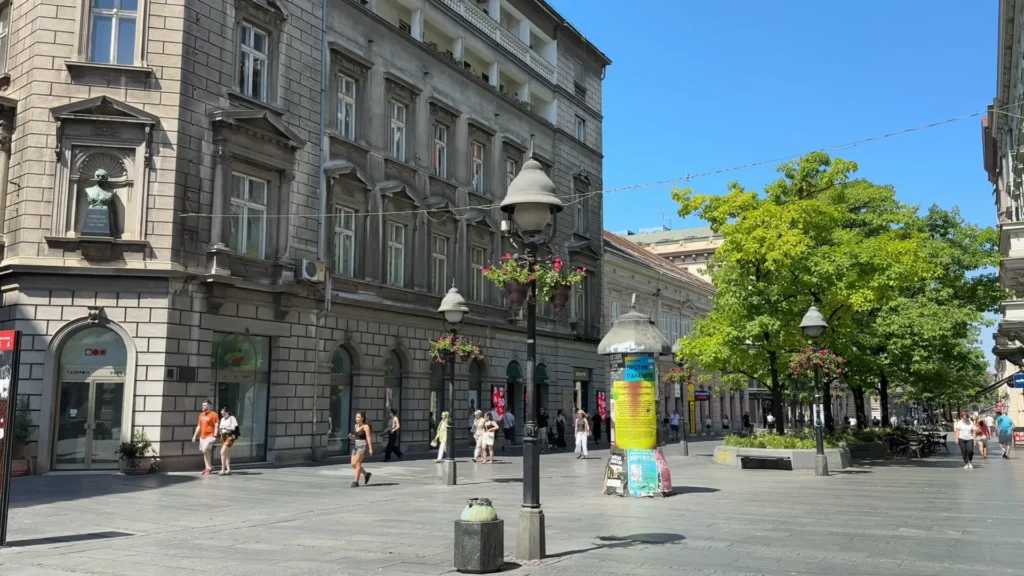
Belgrade is loud, a little scruffy and very hard to dislike.
The city sits where the Sava river runs into the Danube, and its name means “White City.” A bakery on Nemanjina street, Pekara Trpković, is reportedly open around the clock and has been selling burek for over 100 years. That’s Belgrade in one fact.
This guide covers 14 things worth your time on a first visit: 6 for culture, 4 for food and 4 for nights out and fresh air. I’ve ordered them so many of them connect on foot.
A few basics before you start. The center is compact (roughly 5 km across), so most of it is walkable. The currency is the Serbian dinar (RSD), which runs at roughly 117 to the euro, and you’ll want cash for some places (the Tesla Museum takes dinars only).
Public transport has been free since 1 January 2025. Check that it still is when you go, because city policies change.
Prices and opening hours below come from official sites and current guides as of October 2026. Confirm anything you’re building your day around.
With 2 days, I’d pick the fortress, Knez Mihailova, dinner in Skadarlija, cocktails on Strahinjića Bana and a night on the splavovi. With 3 or 4 days, all 14 fit without rushing.
1. Belgrade Fortress and Kalemegdan Park
Start here. Once you’ve watched the Sava and the Danube meet from the ramparts, the rest of the city falls into place.
The fortress has been fought over for centuries, and it shows. Old walls and gates sit inside a huge green park that Belgraders use for dog walks, first dates and long, slow afternoons.
The grounds are free and open 24 hours a day. Paying is optional: the Military Museum charges 350 RSD (about €3) for adults, closes on Mondays and sells its last tickets at 16:00. Tanks and cannons stand outside the building, and that part costs nothing.
The Pobednik (“The Victor”) statue is the photo everyone takes, and it’s a symbol of the city. The Ružica and Saint Petka churches are small, quiet and easy to miss. A few underground spots, like the Roman Well, keep their own hours and sometimes need advance notice, so check before you plan around them.
Allow 2 to 4 hours. I think 2 is plenty if you walk the walls and skip the museum.
Go about an hour before sunset. The light over the confluence is the best free show in town.
The main entrance is at the end of Knez Mihailova street. Trams 2 and 11 stop at Kalemegdanski Park, and the zoo inside the moat charges its own separate admission.
2. Knez Mihailova, Republic Square and the National Museum
Knez Mihailova is the pedestrian street that ties the old center together. One end hits Republic Square, and the other reaches the fortress gate.
Republic Square is where Belgraders agree to meet. The bronze statue of Prince Mihailo on horseback is the spot, and locals say “by the horse” (kod konja) when they set a time with a friend. The National Theatre stands on the same square.
The National Museum is right there too. Its collection includes works by Van Gogh, Monet, Gauguin, Cézanne, Matisse and Picasso, which is more than most people expect from a Balkan capital. Check the current ticket price and hours on the museum’s site, since both have changed over the years.
The street itself is cafés, bookshops and buskers. It’s touristy, and I’d still walk it once, early in the day, before the crowds build.
Sit down for a coffee somewhere along the way. A coffee here can last an hour, and the waiter won’t hover.
Walking from Republic Square down to the fortress takes about 15 minutes at a relaxed pace, which makes this a natural pair with Belgrade Fortress. Skadarlija, the bohemian quarter I cover further down, is also a short walk from the square.
Cost: free to walk. Budget extra only if you go into the museum.
3. Temple of Saint Sava
You’ll see it before you reach it. The white dome rises over the Vračar neighborhood and dominates the skyline from almost every approach to the city.
This is the largest Orthodox church still in use, with room for about 10,000 people. It stands 79 m tall including the cross, and it sits on the plateau where the Ottomans burned the relics of Saint Sava in the late 1500s.
The building’s history is a slog. The idea dates to 1895, construction began in 1935, and the Second World War stopped everything. Work restarted in 1985 after the communist authorities finally approved it, and the main structure was done around 2004. The interior decoration kept going for years after that.
Go inside, then go down. The main space is huge and bright. The crypt below has gold-covered ceilings and mosaics, and it feels completely different, warmer and more intimate.
The temple is open daily from about 08:00 to 20:00 (chapels from 07:00). The address is Krušedolska 2a. Dress as you would for any Orthodox church: cover your shoulders and knees, and men should take their hats off. For crypt and treasury visits, contact the temple’s information service, because those programs run separately.
The plaza out front fills up on warm evenings. I’d time a visit for late afternoon, then stay for the lit dome after dark.
4. Nikola Tesla Museum
Tesla was born in what’s now Croatia to Serbian parents and died in New York. Belgrade still claims him warmly, and his urn is kept here.
The museum is small, in a villa on Krunska Street in Vračar. Visits run as guided tours of about 45 minutes, starting at the top of every hour, and the guide demonstrates working models of Tesla’s machines. If you want to see the Tesla coil in action, you need the tour.
An English tour costs 800 RSD (about €7). The Serbian-language version is 400 RSD. Payment is cash only, in dinars. Cards aren’t accepted, so visit an exchange office or ATM first.
The museum opens Monday from 10:00 to 18:00 and Tuesday to Sunday from 10:00 to 20:00. Individual visitors don’t need to book, but arrive at least 15 minutes before the tour you want. English slots can fill up, so in summer I’d phone ahead (+381 11 2433 886, Monday to Friday, 10:00 to 15:00).
One warning: this is not the Tesla museum in Zagreb. The two aren’t related, and the Belgrade one holds Tesla’s papers, patents and personal items.
I’d rank this near the top for a first visit. It’s short, it’s specific and you leave knowing something you didn’t.
5. Museum of Yugoslavia and the House of Flowers
Yugoslavia is gone, but people in Belgrade still talk about it. This is the best place to find out why.
The complex sits in leafy Dedinje, a residential district of embassies and villas, about 15 minutes from the center by trolleybus or taxi. It has 3 buildings: the May 25 Museum (temporary exhibitions), the Old Museum (gifts that foreign leaders gave Tito) and the House of Flowers, where Josip Broz Tito is buried.
Tito led Yugoslavia until he died in 1980, and his funeral reportedly drew delegations from well over 100 countries. The House of Flowers started life as his winter garden. The wider collection holds more than 200,000 items.
The address is Mihaila Mike Jankovića 6. The museum is closed on Mondays, and the museum’s own site lists a regular ticket at 800 RSD (older guides quote 400, so expect it to have gone up). Hours vary by source, from a 16:00 close to an 18:00 close, so check before you go. Plan 2 to 3 hours.
People across the region disagree about Tito, and the museum doesn’t settle that argument. Go with questions and read the labels closely.
If you want the more recent chapter, the General Staff building on Nikola Pašić Square still stands in ruins from the 1999 NATO bombing. It’s a short walk from the center, and you can see it in 10 minutes.
6. Zemun and Gardoš Tower
Zemun used to sit in another country. Until the First World War it was the last Austro-Hungarian town on the border, facing Ottoman and Serbian Belgrade across the river.
Today it’s a district of Belgrade, and the old town still feels Central European: cobbled lanes, houses in powder pink and yellow, and church spires.
Climb Gardoš Hill to the Millennium Tower (also called the Janos Hunyadi tower). It was built in 1896 to mark 1,000 years of Hungarian settlement in the area. A small fee gets you up the narrow stairs, and the view covers the Danube, the old town’s red roofs and the fortress across the water. Check that the tower is open on the day you go.
Then walk down to the Danube quay. Fish restaurants line the promenade under old plane trees, and a long lunch here is one of the nicest ways to spend a sunny afternoon.
Zemun is a short bus or taxi ride from the center. Give it half a day.
If you only have a day in Belgrade, skip Zemun. If you have 2 or more, it’s the best half-day within the city, and it gets you out of the main tourist flow.
7. Burek for breakfast
If you eat one thing for breakfast in Belgrade, make it burek. It’s thin pastry coiled around meat or cheese, baked in a big round tray and cut to order.
It arrived with the Ottomans centuries ago and stayed. Most bakeries (pekara) sell it, and you’ll see people eating it standing up on the street at all hours.
The name people mention first is Pekara Trpković on Nemanjina street. It has reportedly served the city for over 100 years and runs a counter around the clock. That makes it a useful first stop after a late flight or a last stop after a long night.
Order it the local way: a slice of burek with a bottle of plain drinkable yogurt. It sounds odd. It works.
A small language tip. In Belgrade, burek usually means the meat version. Cheese is typically sirnica and spinach is zeljanica, so ask before you point.
It’s cheap enough that I’d order a second slice. Vegetarians get a good deal here too, since sirnica and zeljanica cover breakfast easily.
Save the sit-down meals for later. This is a breakfast you eat with flaky pastry on your jacket.
8. Ćevapi and pljeskavica with kajmak
Serbia’s national grill food comes in two shapes. Ćevapi are small finger-sized sausages of minced meat, grilled over charcoal. Pljeskavica is a larger flat patty, closer to a bun-less burger.
Both are served with flatbread (lepinja), chopped raw onion and ajvar, a roasted red pepper spread. Many people add kajmak, a soft creamy dairy spread with roughly 60% milk fat. It melts onto the hot meat, and it’s the best part.
Order ćevapi by the number of pieces (5 or 10 is a common portion) and expect to be handed a plate, flatbread and not much else. A lot of grill houses (ćevabdžinica) keep the menu to exactly this, which saves you from deciding.
One guide recommends Ćevabdžinica Savčić in Vračar for both dishes, and there are many more around town. Locals have strong opinions about which is best, and I’d ask your hotel host and see whose name comes up twice.
Don’t fill up on bread. The meat is the point.
Vegetarians will find this part of the cuisine harder. There aren’t many vegetarian restaurants, so the HappyCow listings are worth checking before you arrive.
Here’s a cheap rule: if a grill place has a line of locals at lunch, join the line.
9. Dinner in Skadarlija
Skadarlija is the bohemian quarter of Belgrade, often compared to Montmartre in Paris. It’s a cobbled street (officially Skadarska) lined with old taverns, and it’s a few minutes’ walk from Republic Square.
It earned its reputation in the late 1800s and grew after 1901. That year the well-known Dardaneli inn was demolished, and its guests, who were writers and actors, moved to the taverns here. By the early 1900s the street had 15 kafanas.
Two names matter most. Tri šešira (“Three Hats”) dates to 1864 and is the oldest kafana still working in Skadarlija. Dva jelena (“Two Deer”) claims roots back to 1832 and is one of the most famous. Mali Vrabac (“Little Sparrow”) is a third good option mid-street.
Expect traditional food, a live musician stopping at your table and a bill that’s a little higher than elsewhere in the city. The setting is the point. It’s touristy, and it’s also fun.
Book ahead on weekend evenings, and ask to sit outside when the weather allows. Order grilled meats, a cabbage dish or Karađorđeva šnicla (more on that in the next section), and share a plate of kajmak.
If you want a quieter meal, come early (around 18:00), before the music gets loud and the tour groups arrive.
I’d treat Skadarlija as one evening, not a regular. Eat here once, then explore other neighborhoods for the rest of your trip.
10. Serbian classics and a glass of rakija
After the grill and the pastry, sit down for the dishes that take longer to make. Four are worth ordering.
Karađorđeva šnicla is a Belgrade invention: a thin pork or veal cutlet rolled around kajmak, breaded and fried. It’s rich. Bela Reka restaurant in Belgrade is one place a food guide recommends for it.
Sarma is minced meat and rice rolled in soured cabbage leaves and cooked slowly with smoked meat. It’s the dish you’ll hear described as proper Serbian home cooking.
Gibanica is a cheese pie that’s often served as a starter or a snack. Don’t fill up on it before the main course arrives.
Then there’s rakija, the fruit brandy that goes with almost every meal. Šljivovica, made from plums, is the best known. Sip it. Locals say “živeli” (cheers) and make eye contact when they clink.
For beer, Jelen and Lav are the two local brands you’ll see on most menus.
If you want something more modern, one food writer points to Homa in lower Dorćol, which plays with Serbian staples in creative ways. The same writer’s verdict is that people don’t come to Belgrade to eat, but the restaurant scene gets better every year. I think that’s fair, and the classics above are still where I’d start.
Vegetarians should plan ahead here. Meat sits at the center of most menus, so check HappyCow before you pick a restaurant.
11. Cocktails on Strahinjića Bana
Travel writers have nicknamed Belgrade the “Berlin of the Balkans” for its nightlife, and Strahinjića Bana is where the trendier end of it clusters. Locals call this short Dorćol street “Silicon Valley,” and it’s lined with bars and café terraces that spill onto the pavement.
The land-based bars stay open all year, usually skip any cover charge and care more about the drink than the show. Sneakers are fine. Closing times for bars often fall around midnight or 1 a.m., and the clubs run later.
Smoking indoors is still the default in most Belgrade venues. If smoke bothers you, ask before you sit down, or pick a bar that limits it. One 2026 guide says Krafter keeps the music low and the smoking limited, which makes it good for conversation.
For live music, the same guide points to Josephine, and it suggests booking a table because the room fills up. A few tiny speakeasy-style rooms seat fewer than 20 people, so reserve those too.
Start around 21:00. The city eats late and goes out later, and a 19:00 arrival will find half-empty rooms.
Pair the evening with a walk along Kralja Petra street first. It has shops and eateries, and it works as a slow warm-up before the bars.
Bar menus, owners and names shift fast in Belgrade, so treat any list (including this one) as a starting point. Ask your host which place has been busy this month.
This is where I’d spend the evening if I wanted a good drink and a good chat, with no dress-up and no cover charge.
12. A night on the splavovi
Splavovi (singular: splav) are floating clubs, bars and restaurants moored along the Sava and the Danube. They’ve helped give Belgrade a reputation for some of the most raucous nightlife in Eastern Europe.
Expect big rooms, DJs (some venues book international names) and a late start. Clubs run until the early morning, and many follow a smart dress code, so leave the hiking shoes at the hotel.
Summer is peak season. Some venues scale back or close in winter, so check what’s open before you plan a night around one.
The riverfront near Savamala and the Zemun quay both have clusters. I’d choose one area, then walk between neighbors instead of crossing the city mid-night.
A few cautions. Summer weekends get packed and pricey, so watch your tab and keep an eye on your drink.
Get a ride home through the CarGo app (Serbia’s Uber equivalent) or a licensed white taxi with a plate ending in TX. Don’t flag down a car that looks unofficial.
Redevelopment has displaced some riverfront venues, and names change owners quickly. Ask a bartender or your hotel which splav has the right crowd that month.
Go once. If the club part isn’t your scene, have a drink on the deck at sunset and head back before the music cranks up.
13. Savamala and the riverfront after dark
Savamala is the old warehouse and Art Nouveau district along the Sava. A few years ago, derelict buildings here turned into clubs, galleries, workshops and cultural centres, and the area earned a comparison with the ruin bars of Budapest.
It has a rougher, industrial character than Strahinjića Bana, with warehouse bars and artist spaces. That’s the appeal, and it’s also why you should keep your wits about you late at night.
The Belgrade Waterfront project is chewing into the edges of the neighborhood. It’s a glossy, controversial development that critics compare to Dubai, and you’ll see the cranes and towers from the riverside path.
Beton Hala is a former warehouse hall on the Sava that now holds restaurants and bars. Dom Omladine, the Belgrade Youth Centre, has been staging gigs for over half a century, and it’s worth a look at the program if you want live music over a club.
The nicest walk in this part of town follows the riverside path toward Ušće, past the splavovi. Go at dusk, when the lights come on across the water.
Savamala is roughly a 10 to 15 minute walk downhill from Knez Mihailova. By day it’s quieter, and it’s a good time to look at the street art and poke around the galleries.
This is the part of the city where I’d want a local to point me to the right door. Ask around.
14. Ada Ciganlija, Belgrade’s “sea”
Ada Ciganlija is a river island on the Sava that was joined to the bank and now holds an artificial lake. Belgraders call it “Belgrade’s sea” (More Beograda), and the nickname sticks.
The beach and lake loop run for about 6 to 7 km. In summer, the water reaches around 24°C. The swimming season opens in June.
The island is crowded, and for good reason. In peak season, it can see 100,000 visitors on a normal day and many more on weekends. There are beach bars, floating restaurants, sports courts, a bungee tower and a flat, shaded path made for bikes.
One guide quotes roughly 500 RSD an hour for bike rental. I’d cycle the full loop in the morning, then swim, then eat by the water.
The woods and water create a microclimate that runs a bit cooler than the rest of the city. That matters when July temperatures in Serbia can push above 40°C.
Motorboats are banned on the lake, and dogs aren’t allowed on the beach. Go on a weekday if you can, because summer weekends get very full.
It’s a few kilometers from the center, and buses reach it easily. A taxi works too.
I’d put Ada on the day after a big night out. It’s the best cure for a splav hangover I know of.
Outside summer, the loop is still good for a long walk or a bike ride. The beach bars close, though, so don’t expect to swim.
Conclusion
Belgrade rewards a loose plan and a good appetite.
If you have 3 days, here’s how I’d order the 14. Spend day 1 on the fortress, Knez Mihailova and Republic Square, and dinner in Skadarlija. Spend day 2 on Saint Sava, the Tesla Museum and cocktails on Strahinjića Bana.
Day 3 is for the Museum of Yugoslavia and a long lunch in Zemun. Burek, ćevapi and the Serbian classics slot in wherever you’re hungry. Add the splavovi, Savamala and Ada if you have a fourth day or a late flight.
Book the Tesla tour and the Skadarlija dinner in advance, and carry some dinars. Everything else you can figure out as you go.
Tell me in the comments which one you’d add to the list.
FAQs
How many days do you need in Belgrade?
Three days covers the main list at a relaxed pace. With 2 days, pick the highlights from the intro. Add a fourth day if you want Zemun and Ada Ciganlija without rushing.
Is Belgrade worth visiting?
Yes, especially if you like cities with a rough edge, good grilled food and nights that go late. It’s also cheap compared to many other European capitals, so your money goes a long way at mealtimes.
When is the best time to visit Belgrade?
Late spring and early autumn are comfortable for walking. Summer can get very hot (sometimes above 40°C in July), but that’s also when the splavovi and Ada Ciganlija are at their best. Winter is cold, and the land bars and restaurants stay open.
Is Belgrade safe for tourists?
Most visitors have an easy time, and the usual city sense applies: watch for pickpockets in crowds, use licensed taxis or an app and be careful late at night around clubs. Large demonstrations took place in 2025, and one event page said they remained peaceful for people not taking part. Check your government’s current travel advice before you book.
What currency do I need, and are cards accepted?
The currency is the Serbian dinar (RSD), at roughly 117 to the euro. Many restaurants and shops also accept euros, and exchange offices (menjačnica) are easy to find. Carry cash for places like the Tesla Museum, which takes dinars only.
How do I get from the airport to the city center?
Belgrade Nikola Tesla Airport is about 18 km west of the center. The A1 minibus runs to Slavija Square in about 30 minutes for roughly 300 to 400 RSD. City bus 72 goes to Zeleni Venac and is free. The official airport taxi has a fixed fare of around 3,000 to 3,500 RSD (€25 to €30), which you can arrange at the Taxi Info desk in the arrivals hall.
Is public transport free in Belgrade?
A 2026 airport guide says all regular city lines have been free since 1 January 2025. Policies change, so confirm when you arrive.
Do I need a visa for Serbia?
Citizens of the USA and European countries don’t need a visa for short stays, according to a recent conference travel page. Other nationalities should check the rules with Serbian authorities before booking. Foreign visitors need to be registered with the local police within 24 hours of arrival, and hotels usually handle it, so ask at check-in if you rent a private apartment.
Is Belgrade good for vegetarians?
It takes some planning. Meat sits at the center of most traditional menus, and there aren’t many vegetarian restaurants. Sirnica (cheese pastry) and zeljanica (spinach pastry) work for breakfast, and the HappyCow listings and places like Gnezdo Organic Restaurant are good starting points.